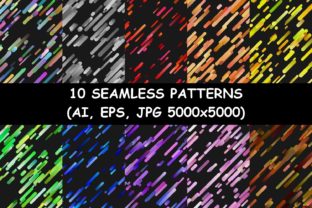
10 Seamless Gradient Stripe Patterns
10 Seamless Gradient Stripe Patterns is a curated digital design resource package offering ten distinct, repeatable background designs. Each pattern features smooth color transitions across diagonal or horizontal stripe arrangements, with rounded edges and consistent spacing to ensure visual harmony when tiled. The collection includes vector files (AI and EPS formats) for infinite scalability and high-resolution JPGs sized at 5000×5000 pixels—suitable for both screen and print applications.
What This Package Offers—and What It Doesn’t
The package delivers exactly what its title states: ten unique gradient stripe patterns, all built to tile seamlessly without visible seams or alignment breaks. Each design is abstract, contemporary in aesthetic, and optimized for versatility—supporting modern UI elements, presentation slides, branding assets, or textile-inspired web backgrounds. It does not include editable color palettes beyond the vector source files, nor does it provide customization tools, tutorials, or licensing guidance beyond standard commercial use terms.
Why Designers and Developers Consider This Collection
Professionals often seek seamless patterns to add subtle texture or directional energy to interfaces without overwhelming content. Gradient stripes—particularly diagonal and rounded variants—introduce movement and depth while retaining minimalism. Users evaluating 10 Seamless Gradient Stripe Patterns typically do so because they need:
- Consistent, production-ready assets that integrate quickly into existing workflows;
- Scalable vector versions for responsive design systems or large-format print;
- High-resolution raster files for platforms that don’t support vector backgrounds;
- A cohesive set of variations—rather than isolated one-offs—to maintain stylistic continuity across projects.
Because each pattern is individually crafted—not algorithmically generated—the collection avoids the repetition fatigue common in procedural pattern libraries. That makes it especially useful for designers who prioritize intentional visual rhythm over sheer volume.
Practical Benefits and Real-World Expectations
Vector formats (AI and EPS) allow users to adjust stroke width, corner radius, or gradient stops directly in Adobe Illustrator or compatible software. This means limited but meaningful customization—such as shifting hue balance or adapting contrast for accessibility—without losing fidelity. The JPGs offer immediate usability: no software dependency, fast loading in web environments, and compatibility with CMS platforms that restrict SVG uploads.
However, expectations should align with scope. These are static backgrounds—not dynamic or animated. They won’t adapt to user interaction, dark mode toggles, or viewport changes unless manually implemented via CSS or JavaScript. Also, while the 5000×5000 JPG resolution supports most standard displays and moderate print sizes, ultra-high-DPI output (e.g., billboard-scale printing) may require upscaling or additional interpolation—potentially affecting edge clarity in rounded elements.
When This Package Fits Well
10 Seamless Gradient Stripe Patterns is a strong fit for teams or individuals working under time constraints who value consistency and polish. It suits scenarios such as:
- Creating branded slide decks where background subtlety reinforces tone without competing with content;
- Designing SaaS dashboard components where soft diagonal motion suggests progression or data flow;
- Developing marketing landing pages that benefit from tactile, non-photographic texture;
- Building design system documentation that demonstrates how gradients interact with layout grids and typography;
- Producing social media templates where uniformity across posts improves brand recognition.
In these cases, having ten thoughtfully spaced, harmonized options reduces decision fatigue and accelerates iteration—especially when paired with a defined brand palette. Because the patterns avoid extreme saturation or narrow contrast ratios, many work well with light or dark text overlays, assuming appropriate foreground contrast is verified.
When Alternatives May Be More Appropriate
This package is less ideal when flexibility outweighs immediacy. For example:
- If you need full control over gradient direction, opacity mapping, or parametric variation per stripe, generative tools (like CSS repeating-linear-gradient or Figma plugins) offer greater runtime adaptability;
- If your project demands accessibility-first backgrounds—such as low-contrast, high-luminance, or motion-free alternatives—this collection’s emphasis on visual interest may require manual validation against WCAG guidelines;
- If you’re building a long-term design system with frequent theme updates, relying solely on static JPGs limits future responsiveness; SVG-based pattern libraries or CSS variables may scale more efficiently;
- If budget is constrained and only one or two patterns are needed, purchasing a single asset from a microstock platform—or generating a custom variant using open-source tools—could reduce cost without sacrificing quality.
Also, while the rounded stripe motif is current, trends in digital design evolve. A collection focused exclusively on this style may feel dated in 2–3 years if interface conventions shift toward flatter, grid-based, or organic fluid shapes. Evaluating longevity alongside present utility helps balance short-term efficiency with longer-term maintainability.
Making an Informed Choice
To determine whether 10 Seamless Gradient Stripe Patterns meets your needs, consider three practical checkpoints:
- Workflow alignment: Do you regularly use Illustrator or similar vector tools? If yes, the AI/EPS files add tangible value. If not, and you rely heavily on web-native tools like Figma or CSS, assess whether the JPGs alone meet your resolution and tiling requirements.
- Project scope: Are you producing multiple deliverables across formats (web, PDF, print)? Then having both scalable vectors and high-res JPGs justifies the package structure. For single-use web banners, simpler alternatives may suffice.
- Design intent: Does your goal involve introducing gentle motion or directional emphasis without drawing attention away from primary content? If so, diagonal gradient stripes serve that purpose effectively. If you aim for neutrality or strict functional minimalism, even subtle patterns may introduce unnecessary visual weight.
No single pattern library solves every problem. What makes 10 Seamless Gradient Stripe Patterns useful is its focused execution—not breadth, but cohesion. It fills a specific niche: ready-to-deploy, aesthetically unified, technically sound stripe-based gradients. Its value emerges not in isolation, but in how efficiently it integrates into decisions already shaped by brand guidelines, technical constraints, and audience context.