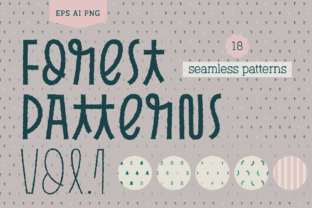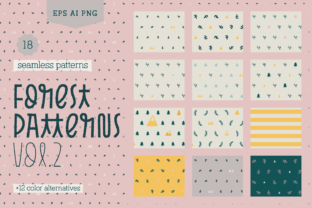
Forest Patterns Vol. 2: A Strategic Asset for Purpose-Driven Design
Forest Patterns Vol. 2 isn’t just another pattern pack—it’s a deliberately crafted toolkit for designers, publishers, product developers, and brand builders who prioritize intentionality over ornamentation. With 18 seamless vector patterns built from refined natural motifs—trees, pine silhouettes, branching forms, triangular mountains, rhythmic dots, and clean lines—it bridges aesthetic coherence with functional flexibility. Unlike static assets that lock you into fixed palettes or scales, Forest Patterns Vol. 2 is engineered for adaptability: every pattern is fully editable in Adobe Illustrator, scalable without loss, and designed to tile flawlessly across surfaces of any size.
Why Seamless Vector Patterns Matter in Real-World Projects
Seamless vector patterns are more than decorative elements—they’re structural components of visual communication. When applied thoughtfully, they reinforce tone, support narrative, and unify touchpoints. A stationery line using Forest Patterns Vol. 2 gains consistency not through repetition alone, but through shared visual language: the same pine motif can appear subtly on a business card, confidently on a book spine, and richly on wrapping paper—all while preserving brand recognition. That cohesion reduces cognitive load for customers and strengthens recall. For educators creating nature-themed learning materials or small businesses launching eco-conscious packaging, this isn’t about “adding green”—it’s about aligning visual infrastructure with mission and audience expectation.
Strategic Use Cases Across Industries
The versatility of Forest Patterns Vol. 2 emerges most clearly when matched to specific outcomes—not just applications. Consider these grounded examples:
- Publishers and authors use Patterns 10 and 11 (delivered at 6000 × 6000 px for complexity) as textured backgrounds in illustrated children’s books or botanical field guides—where detail must hold up in print and digital formats alike.
- Small-batch stationery brands import the .AI swatch library directly into Illustrator’s Swatches Panel, then recolor entire pattern sets in under two minutes to match seasonal collections—say, deep forest greens for autumn launches or muted greys and creams for minimalist wedding suites.
- Product designers apply scaled-down versions of the line-based patterns (provided at 460 × 500 px) as subtle textures on label die-lines or QR code borders—adding tactility without compromising scannability or regulatory clarity.
- Event planners and greeting card creators layer simplified tree or branch motifs over matte-finish Christmas cards, then adjust opacity and blending modes to evoke warmth without clutter—leveraging the included reference PDF to locate the right pattern fast, not guess.
Planning Your Pattern Integration—Before You Open Illustrator
Introducing Forest Patterns Vol. 2 into a project without strategic framing risks visual dilution. Ask yourself three questions before importing a single swatch:
- What role does texture play in this piece? Is it meant to ground (e.g., mountain triangles anchoring a poster layout), soften (e.g., fine dot patterns diffusing harsh white space), or signal (e.g., pine boughs reinforcing an outdoor brand’s ethos)? If the answer is “just because it looks nice,” pause.
- Where will this scale—and how will fidelity hold? The PNG variants are purpose-built: 3000 × 3000 px covers most print needs; the larger 6000 × 6000 px files exist for intricate patterns where pixel-level nuance matters. Using the smaller PNGs for billboard-sized murals invites visible interpolation—vector editing avoids that entirely, but only if you start in AI or EPS.
- How many color systems does this project require? The 12 additional color alternatives aren’t decorative extras—they’re pre-tested harmonies. Rather than adjusting hues manually and risking imbalance, treat them as modular palettes: one for primary branding, another for limited-edition runs, a third for accessibility-compliant contrast variants.
Avoiding Common Pitfalls—When Flexibility Becomes a Liability
Having 18 patterns, multiple resolutions, and 13 total color options sounds like abundance—until decision fatigue sets in. Without clear constraints, designers often default to “safe” choices: the most symmetrical pattern, the most neutral palette, the smallest scale. That leads to sameness—not strategy. Worse, applying seamless patterns without considering rhythm and density can overwhelm content. A dense branch motif behind body text, for example, undermines readability no matter how elegant the illustration.
To mitigate this, treat Forest Patterns Vol. 2 like a physical material sample book: test at actual size, under real lighting (not just screen preview), and alongside final typography and photography. Use the reference PDF not just to identify patterns, but to compare density, line weight, and negative space side-by-side. And remember—the included vector files let you delete or simplify individual elements (e.g., removing interior branch details to increase breathing room). That power only delivers value when exercised deliberately.
Long-Term Value: Beyond One-Off Projects
Forest Patterns Vol. 2 pays dividends across time—not just per project. Because all assets are vector-based and built with layered, named objects in Illustrator, they integrate cleanly into design system libraries. You can extract a single pine silhouette and convert it into a custom icon; isolate a mountain shape to build a cohesive set of infographics; or combine dot and line patterns to generate new hybrid textures. This isn’t speculative reuse—it’s documented capability. The .AI swatch file, for instance, doesn’t just drop patterns into your panel—it preserves their construction logic, making future edits predictable and repeatable.
For freelancers managing multiple clients, that means faster onboarding: a new eco-brand gets immediate access to a vetted, on-brand pattern foundation—not generic stock. For educators building curriculum resources, it means students learn pattern logic *through* the files—not just by looking at them. And for small business owners updating packaging seasonally, it means swapping colors and scaling elements in minutes instead of hours—freeing mental bandwidth for customer-facing decisions, not technical troubleshooting.
Making the Choice: Is Forest Patterns Vol. 2 Right for Your Next Step?
It is—if your goal is coherence, not just decoration; scalability, not just convenience; and intentionality, not just speed. It is not a shortcut for weak concept development. It won’t compensate for unclear messaging or mismatched audience expectations. But when aligned with thoughtful planning—when used to express, not distract, and to unify, not merely fill—it becomes infrastructure. Not flair. Not filler. Infrastructure.
The patterns themselves are quiet. They don’t shout. They respond. They adapt. They hold space—so your ideas, products, and stories can occupy it with clarity. That’s the quiet leverage in Forest Patterns Vol. 2: not what it adds, but what it enables you to say, build, and sustain—without visual noise getting in the way.