Sunflower Patterns Collection
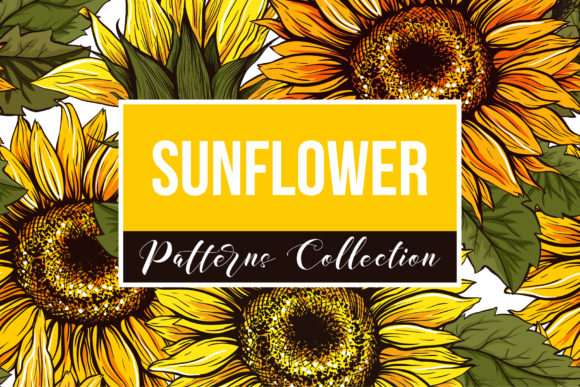
There’s a reason sunflowers catch the eye—and not just because they’re bold and bright. Their symmetry, rhythm, and natural warmth translate powerfully into pattern design. The Sunflower Patterns Collection brings that energy into your creative workflow: four cohesive, seamless sunflower motifs built for versatility, consistency, and visual impact. Each pattern balances stylized black outlines with vibrant yellow tones—grounded, joyful, and unmistakably sunny—designed to feel intentional, not decorative filler.
This isn’t just clipart repackaged. Every pattern is constructed with repeat logic in mind: no awkward seams, no pixelated edges, no guesswork when scaling. Whether you're printing wallpaper for a cozy reading nook or designing a limited-run textile line, these patterns hold up—cleanly, confidently, and consistently.
What You Actually Get (And Why It Matters)
The collection delivers production-ready assets across formats—not as an afterthought, but by design:
- 4 seamless patterns in EPS (vector, editable), high-res JPEG (6000 × 6000 px, 300 dpi), PNG (transparent background), and SVG (web-optimized, scalable)
- 10 standalone sunflower graphic elements in PNG (transparent background), plus one consolidated EPS file grouping them all
- 3 colored sunflower variants in both PNG and SVG—specifically optimized for sublimation printing on mugs, apparel, and home goods
No upsells. No missing files. No “you’ll need to edit this yourself” surprises. Everything is organized, labeled clearly, and tested across platforms—from Adobe Illustrator to Canva, Cricut Design Space to Silhouette Studio. If you’ve ever opened a download only to find mismatched resolutions or ungrouped vectors, you’ll appreciate how thoughtfully this set is assembled.
Creative Uses That Go Beyond “Pretty Backgrounds”
Sunflowers aren’t just for summer-themed blogs or garden parties. Their graphic strength makes them adaptable across contexts—if you know how to pivot the style and scale.
A small business owner launching eco-friendly stationery might use the minimalist sunflower pattern as a subtle watermark behind hand-lettered quotes on greeting cards—keeping branding present without overwhelming the message. A teacher creating classroom visuals could drop the bold-lined sunflower motif into a printable behavior chart, using color coding (yellow = positive reinforcement) to support visual learners.
For digital creators: the SVG patterns load instantly on websites and work flawlessly in responsive CSS backgrounds. Pair one with a clean sans-serif font and ample white space—it becomes modern, approachable, and quietly confident. For print-on-demand sellers, the sublimation-ready sunflower elements let you build layered designs fast: place a centered SVG sunflower over a textured background, add a short phrase in a complementary typeface, and you’ve got a cohesive mug or tote bag series—no illustration skills required.
Designing With Intention—Not Just Decoration
Strong pattern use starts with purpose. Ask yourself: What feeling do I want to evoke? What action should the viewer take? How much visual weight does this element need in relation to text, photos, or other graphics?
For example, the high-contrast black-and-yellow sunflower pattern works best at medium-to-large scale—think fabric yardage, wall decals, or presentation slide headers. Used too small, the detail blurs; used too densely, it competes. But scaled to cover 30% of a social media banner, with copy overlaid in a neutral gray, it creates focus and warmth without distraction.
Conversely, the individual sunflower elements shine in editorial layouts: scattered lightly along a blog post divider, grouped as bullet points in a newsletter, or arranged asymmetrically around a product photo. Because each PNG includes transparency, they integrate cleanly—no white boxes, no manual erasing.
Who Benefits—and How They Use It Differently
Freelance designers use the EPS files to customize repeats for client projects—adjusting spacing, recoloring stems, or isolating petals to build custom borders. The vector flexibility means no loss of quality, whether adapting for a boutique logo lockup or a festival poster series.
Educators and content creators rely on the transparent PNGs for accessible, low-friction visuals—adding sunflower accents to Google Slides templates, Canva lesson plans, or printable worksheets. No design degree needed; just drag, resize, and go.
Small batch makers (think ceramicists, candle pourers, sticker artists) turn to the sublimation-optimized SVGs and PNGs for consistent, crisp transfers—even on curved surfaces. The clean lines hold up through heat press cycles, and the yellow tones remain vivid against light or dark substrates.
Bloggers and marketers use the JPEG patterns as email header backgrounds or Pinterest pin overlays—knowing the 6000 × 6000 px resolution ensures sharpness across devices, from mobile feeds to desktop thumbnails.
Keeping It Cohesive Without Being Repetitive
Having four distinct patterns gives you room to vary tone without losing unity. Try pairing the tight, dense sunflower repeat for packaging foil stamping with the loose, spaced-out version for a breathable website background. Or use one pattern in full color for a product label and its monochrome SVG counterpart for a minimalist business card.
Consistency comes from restraint—not repetition. Choose one primary pattern for your core brand application (e.g., website + print collateral), then bring in the standalone elements for secondary touches (social icons, email dividers, presentation accents). That way, your audience recognizes the motif without feeling saturated.
Final Thought: Tools Enable, But Vision Directs
The Sunflower Patterns Collection is a practical resource—not a creative shortcut. Its value lies in how efficiently it supports your existing process: reducing setup time, expanding format options, and maintaining visual integrity across touchpoints. Whether you’re sketching ideas on paper or building a Shopify store from scratch, these assets meet you where you are—and give you room to refine, adapt, and make something distinctly yours.
Start small. Test one pattern in a real context—a single Instagram story, a printed tag, a section of a mood board. See how the yellow reads in natural light. Notice how the black outline holds up next to your brand fonts. Then build outward. That’s how strong, audience-friendly design takes root.