Terrazzo Seamless Patterns
If you've noticed a subtle but unmistakable shift in design lately—clean layouts punctuated by soft, granular texture; minimalist packaging with quiet visual depth; social feeds where backgrounds feel tactile, not flat—you’ve likely encountered Terrazzo Seamless Patterns. This isn’t just another trend riding the wave of nostalgia. It’s a versatile, scalable, and deeply practical design resource built for real work—not just mood boards.
What Exactly Is Terrazzo Seamless Patterns?
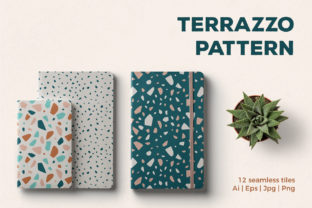
At its core, Terrazzo Seamless Patterns is a curated collection of 12 high-fidelity, tileable patterns inspired by traditional terrazzo flooring—but stripped of clutter and optimized for digital and print use. Each pattern mimics the organic, speckled composition of crushed stone, glass, or marble set in resin, yet rendered with precision: no visible seams, no pixelation, no awkward repeats. What makes it “seamless” isn’t just technical—it’s functional. You drop it into a layout, scale it up for a billboard or down for an app icon background, and it holds its integrity.
Where These Patterns Actually Shine (Beyond the Obvious)
Designers often reach for terrazzo when they want “texture without noise”—but the real power lies in how quietly effective it is across wildly different contexts:
- Brand Identity Systems: A startup launching a sustainable skincare line used one of the lighter, warm-toned patterns as a subtle background layer behind their logo lockup on business cards and website headers. It added warmth and tactility without competing with typography—something solid-color gradients couldn’t achieve.
- Packaging That Stands Out on Shelves: A small-batch coffee roaster printed a muted, gray-based terrazzo pattern onto matte kraft boxes. Because the pattern is low-contrast and grainy—not graphic or bold—it felt artisanal and grounded, helping them avoid looking “trend-chasing” while still feeling contemporary.
- Social Media Visuals: Instagram carousel posts often suffer from visual fatigue. One wellness coach layered a soft, desaturated terrazzo pattern as a semi-transparent overlay behind quote graphics. The result? Text remained highly legible, but the background gained dimension—no stock photo needed, no licensing hassle.
- Textile & Surface Design: A fabric designer testing repeat patterns for upholstery samples scaled one of the EPS files to 300% and dropped it into her textile CAD software. Because the AI and EPS files are vector-based, she adjusted color palettes to match seasonal collections—and exported at exact millimeter repeats required by her manufacturer.
- Digital Product UI: A fintech team used a fine-grained, neutral terrazzo pattern as a subtle backdrop for dashboard cards. It softened sharp UI edges and reduced visual glare during long screen sessions—without triggering accessibility concerns like busy photographic textures might.
Why Format Variety Matters More Than You Think
This pack includes 12 patterns in AI, JPEG, PNG, and EPS formats—and that’s not redundancy. It’s flexibility baked in:
- AI files let you open, recolor, reposition, or rescale individual chips (the “particles”)—ideal if your brand palette shifts or you need to adapt contrast for dark mode.
- JPEGs (2000px × 2000px, 300dpi) are ready for immediate use in Photoshop, Canva, or InDesign—no setup, no tracing, no guesswork.
- PNGs give you clean transparency, perfect for overlays, app icons, or web elements where the background changes dynamically.
- EPS files ensure compatibility with older prepress workflows or large-format printers—still widely used in signage, exhibition builds, and specialty print vendors.
You’re not choosing *one* format—you’re keeping options open. A freelance designer once reused the same pattern across a client’s trade show booth (EPS), Instagram Stories (PNG), and product labels (JPEG)—all in under two hours.
Real Considerations Before You Jump In
Terrazzo Seamless Patterns works beautifully—but like any tool, it has sweet spots and soft edges:
- Scale awareness matters: While seamless, extremely tight zooms (like micro-printing on garment tags) may reveal subtle repetition. For most applications—web, packaging, apparel, presentations—it’s imperceptible. Just avoid using a single tile at 500% magnification in a tiny space.
- Color context is everything: A cool-toned pattern can read as sterile next to warm brand colors. That’s why editable AI files help—you don’t need to hunt for “the right version.” Adjust saturation, shift hue, or mute brightness in seconds.
- It’s texture, not storytelling: Terrazzo adds atmosphere, not narrative. If your project needs strong symbolism (e.g., cultural motifs, data visualization), pair it with intentional illustration—not rely on the pattern alone.
- Print vs. screen perception differs: A pattern that looks balanced on screen may feel busier on uncoated paper. Always soft-proof with a physical sample if quality is mission-critical—especially for luxury packaging.
Who Benefits Most—and How
Freelance designers love this pack because it shortens revision cycles. Clients ask, “Can we make it warmer?” → Open the AI file, tweak three swatches, export fresh JPEGs. Done.
In-house brand teams use it to maintain consistency across departments. Marketing drops PNGs into Mailchimp templates; Product uses EPS for spec sheets; Retail applies JPEGs to shelf talkers—all pulling from the same source, same tone, same quality.
Small-business owners without design support find the JPEGs especially approachable. Upload one to Canva, set it as a background, add text—and suddenly your Etsy banner or LinkedIn cover feels intentionally designed, not templated.
Students and emerging creatives use the AI files to reverse-engineer composition: How dense are the particles? Where’s the balance between negative space and texture? It’s a quiet masterclass in controlled randomness.
Not Just “Trendy”—But Thoughtfully Built
Yes, terrazzo is having a moment—but what separates Terrazzo Seamless Patterns from generic free downloads is intentionality. Every particle placement avoids rigid symmetry. Each color blend was tested for accessibility contrast. All 12 patterns share tonal harmony so mixing them feels cohesive, not chaotic. And because they’re built at 2000px × 2000px and 300dpi, they hold up whether you’re printing a 10-foot banner or exporting a 128px favicon background.
It’s minimal—but never empty. Textured—but never overwhelming. Seamless—but never soulless. That balance is rare. And when your deadline’s looming, your client’s picky, and your creative energy’s running thin? That balance isn’t just nice. It’s necessary.