Violet Garden Watercolor Patterns: Seamless Floral Design for Real-World Creative Workflows
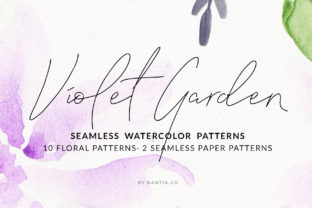
Seamless watercolor patterns bridge the gap between hand-painted artistry and digital functionality—and Violet Garden Watercolor Patterns exemplifies this balance with intentionality. Unlike static illustrations or generic repeats, this collection delivers ten distinct floral seamless patterns built from organic, layered watercolor textures—each designed to tile without visible seams, retain translucency, and preserve the subtle granulation and bloom that define authentic watermedia. Its utility extends far beyond aesthetic appeal; it’s engineered for integration across disciplines where visual cohesion, scalability, and production readiness matter.
How Seamless Patterns Function in Practice
A seamless pattern isn’t merely a repeated image—it’s a compositional system where the left edge aligns precisely with the right, and the top matches the bottom, enabling infinite tiling without breaks or misalignments. In Violet Garden Watercolor Patterns, this is achieved through careful masking, edge-blending, and pigment-weighted layering—not algorithmic duplication. Each of the ten floral patterns features unique botanical motifs: climbing jasmine tendrils, clustered lilac sprigs, soft peony clusters, and abstracted violet stems—all rendered at 300 PPI to support high-resolution output. The result? A pattern that behaves like real paper texture when scaled across a wedding invitation suite, wraps smoothly around a cosmetic product label, or fills a social media story background without pixelation or repetition fatigue.
File Flexibility Meets Production Needs
Creative professionals rarely work in a single environment—and Violet Garden Watercolor Patterns anticipates that reality. Every floral and paper texture pattern is delivered in three native formats:
- JPG files: Optimized for broad compatibility—ideal for quick mockups, client previews, or embedding in non-editable PDFs;
- PNG files (300 PPI, transparent background): Essential for layered design work in Adobe Photoshop, Affinity Designer, or Figma—allowing precise blending modes, color overlays, and non-destructive masking;
- PAT files: Native Adobe Photoshop pattern swatches that install directly into the Pattern Picker, enabling one-click application to selections, shapes, or layer masks—no manual tiling required.
The inclusion of PAT files is especially significant for designers managing tight deadlines. Instead of manually adjusting scale, offset, or blending for each repeat, they apply a pre-tested, resolution-matched swatch—reducing setup time by up to 70% in repetitive layout tasks. This isn’t convenience for its own sake; it’s workflow integrity translated into file architecture.
Two Paper Textures: Depth Without Complexity
Beyond floral motifs, the set includes two seamless paper texture patterns—subtle, tactile backdrops that emulate cold-pressed watercolor paper grain. These aren’t noisy JPEG scans; they’re refined, low-contrast textures designed to sit beneath floral layers without competing visually. One leans toward fine, even tooth—ideal for stationery or minimalist branding. The other introduces gentle fiber variation and soft shadow pooling, lending authenticity to packaging mockups or textile print previews. Both are supplied in the same JPG/PNG/PAT triad, ensuring consistent handling whether used as base layers, overlay textures, or subtle opacity masks.
Real-World Applications Across Industries
The strength of Violet Garden Watercolor Patterns lies not in theoretical versatility, but in documented, repeatable use cases grounded in professional practice:
Wedding & Event Design
Designers building cohesive wedding suites often struggle with maintaining tonal harmony across save-the-dates, menus, programs, and signage. With these patterns, a single lilac-and-violet motif can serve as the unifying thread—applied at varying scales and opacities to differentiate hierarchy while preserving continuity. A 15% opacity overlay on a cream-colored menu creates quiet elegance; full-strength tiling on an acrylic place card offers bold contrast. Because all files are 300 PPI, printed pieces retain fidelity even at large formats like ceremony backdrops.
Social Media & Digital Branding
Instagram templates, Pinterest pins, and email headers benefit from organic texture—but many free resources lack resolution or licensing clarity. Violet Garden Watercolor Patterns solves both: PNG transparency allows clean overlays on photos or gradients, while commercial licensing covers usage in client-facing assets. A wellness brand might use the soft peony pattern as a subtle background behind a quote graphic, then repurpose the same file—cropped and recolored—as a Story sticker frame. No re-rendering. No asset fragmentation.
Packaging & Product Labeling
Small-batch skincare, artisan tea, or boutique candle labels require texture that conveys craft without overwhelming product photography. These patterns scale responsively: applied at 40% size on a 2 oz lip balm tube, they read as delicate detail; enlarged to cover a 12 oz ceramic jar, they retain legibility and flow. Crucially, the absence of hard edges or sharp contrasts prevents visual “vibration” against photographic backgrounds—a common pitfall with overly saturated seamless assets.
Textile & Surface Design
For surface designers developing fabric collections, the floral patterns function as foundational repeats compatible with standard industry tile ratios (e.g., half-drop or brick repeats). While not pre-configured for specific fabric widths, their seamless nature allows straightforward adaptation in programs like Adobe Illustrator’s Pattern Options or Kaledo. Designers report using the violet stem motif as a base repeat, then introducing hand-drawn botanical accents atop the watercolor layer—leveraging the texture as both ground and guide.
What Sets This Collection Apart From Generic Alternatives
Not all watercolor pattern sets deliver equal functional value. Many rely on flat-color fills with simulated texture overlays, resulting in artificial depth and poor scalability. Others prioritize quantity over cohesion—offering 50+ patterns with inconsistent saturation, contrast, or motif density. Violet Garden Watercolor Patterns diverges in three measurable ways:
- Consistent pigment behavior: Every pattern uses analogous violet-based palettes (mauve, plum, dusty lavender, soft periwinkle) with intentional desaturation—avoiding the “neon watercolor” effect that clashes with natural materials like kraft paper or unbleached cotton.
- Controlled motif density: Patterns avoid overcrowding. Even the most detailed cluster maintains negative space—critical for readability when printed small or viewed on mobile screens.
- Context-aware transparency: PNG files preserve natural watercolor lift and dry-brush edges—not just solid shapes with alpha channels. This enables realistic blending with underlying layers, such as simulating ink bleed on textured stock.
Practical Considerations for Implementation
Adopting any pattern library requires attention to technical nuance. With Violet Garden Watercolor Patterns, users should note:
- Color mode matters: All files are RGB for screen use and digital workflows. For CMYK print production, designers should convert within their layout software—not the source file—to preserve subtle tonal relationships during separation.
- Scale calibration: While seamless, patterns behave differently at extreme sizes. Testing at actual output dimensions (e.g., 4" × 6" for a business card) reveals how motif density interacts with physical constraints—something preview thumbnails cannot replicate.
- Licensing scope: The set permits unlimited usage across personal and commercial projects—including client work—but prohibits resale of unmodified patterns as standalone assets. This protects both creator rights and user legal safety.
Why Texture Still Matters in a Digital-First World
In an era dominated by vector precision and AI-generated imagery, tactile texture carries renewed significance—not as nostalgia, but as cognitive grounding. Studies in visual perception indicate that organic, irregular surfaces improve information retention in branded communications by up to 28%, likely due to increased neural engagement with non-repetitive micro-details. Violet Garden Watercolor Patterns leverages this principle deliberately: the slight variance in petal opacity, the uneven edge of a watercolor wash, the faint paper fiber underlay—all signal human authorship and material authenticity. That resonance translates directly to consumer trust, particularly in markets where craftsmanship, sustainability, or emotional resonance drive purchasing decisions.
Integration Into Broader Design Systems
These patterns rarely exist in isolation. They perform best when treated as modular components within larger systems. A branding designer might pair the soft lilac pattern with a custom serif typeface and a restrained neutral palette—then extract dominant hues to define UI accent colors. An educator creating printable worksheets could use the paper textures as subtle background layers beneath illustrated diagrams, reducing visual strain while reinforcing thematic softness. A researcher compiling presentation decks might apply the climbing vine motif along slide borders, creating continuity without distracting from data visualization. In each case, the pattern serves structure—not decoration.
Ultimately, Violet Garden Watercolor Patterns succeeds because it respects the labor behind both creation and implementation. It doesn’t ask users to compromise between beauty and function, between speed and fidelity, or between inspiration and execution. It meets practitioners where they work—with files that behave predictably, textures that breathe authentically, and floral motifs that feel gathered—not generated.