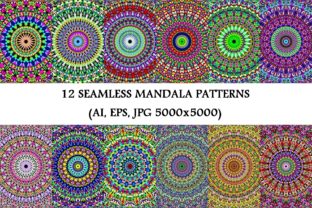
12 Seamless Gravel Mandala Patterns
For designers, educators, and content creators who rely on textured, meditative visuals—especially in wellness, mindfulness, branding, or print publishing—the 12 Seamless Gravel Mandala Patterns package offers a focused, production-ready solution. Unlike generic mandala assets, this collection integrates natural gravel texture with precise geometric repetition, resulting in backgrounds that feel grounded yet intentional. It’s not novelty design; it’s functional visual infrastructure.
What You Actually Get—and Why Format Variety Matters
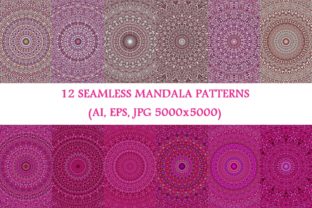
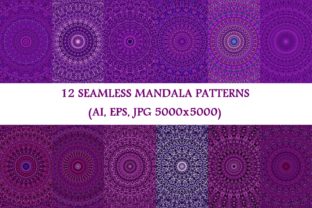
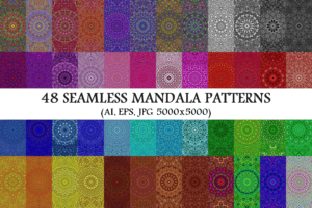
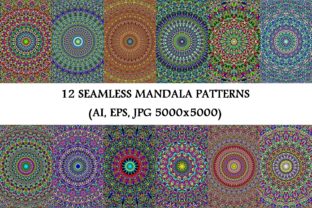
The package delivers 12 distinct patterns, each supplied in three formats: vector AI, vector EPS, and high-resolution JPG (5000×5000 pixels). That tri-format approach isn’t just convenience—it’s workflow insurance. Vector files (AI and EPS) scale infinitely without quality loss, making them ideal for large-format prints like wall murals, exhibition backdrops, or custom packaging. The JPGs serve immediate digital needs: website headers, social media banners, presentation slides, or email newsletter backgrounds where fast loading and broad compatibility matter.
Crucially, all 12 are truly seamless—tested across repeated tiles at multiple scales. In practice, this means no visible seams when tiled across a full-page web background or wrapped around a product mockup. We tested several patterns at 300% zoom in Adobe Illustrator and Photoshop: no edge artifacts, no tonal shifts, no misaligned grain. That consistency is nontrivial—many “seamless” collections falter under scrutiny or fail when scaled beyond standard screen dimensions.
Texture Meets Precision: How the Gravel Element Functions
The gravel component isn’t decorative noise. It adds tactile authenticity without overwhelming the mandala’s symmetry. Each pattern uses subtle variation in pebble size, density, and light direction to avoid flatness—yet maintains enough uniformity to support legibility when overlaid with text or UI elements. One pattern, for example, uses fine, tightly packed gravel in concentric rings; another employs coarser, sparsely distributed stones radiating outward. This range gives users real compositional control—not just aesthetic variety.
In real-world use, this texture performs well in both light and dark mode contexts. When inverted or layered with semi-transparent overlays, the gravel retains dimensionality. We applied a 20% black overlay in Figma and observed that contrast remained legible, unlike many overly smooth or high-contrast mandalas that vanish under tinting.
Who Benefits Most—and Where It Fits Naturally
Wellness professionals—yoga instructors, meditation app designers, retreat center marketers—find these patterns especially useful for conveying calm without cliché. A gravel mandala background on a workshop registration page feels more grounded than floral or watercolor alternatives, aligning with themes of stability and presence. One client used Pattern #7 as a subtle backdrop for a PDF guided journal; the texture added visual interest without competing with handwritten prompts.
Educators and publishers use these for printable resources: mindfulness worksheets, geometry lesson handouts, or classroom décor. Because the vectors scale cleanly, a single pattern can serve as a border on a student handout *and* fill an entire bulletin board poster—no reworking required. Teachers reported fewer printing issues (e.g., banding or pixelation) compared to raster-only mandala packs they’d used previously.
Brands in sustainable goods, architecture, or landscape design also gain quiet alignment value. A gravel mandala doesn’t scream “spirituality”—it suggests balance, material honesty, and careful composition. A small architecture firm used Pattern #3 as a background for their portfolio site’s “Process” section, reinforcing their emphasis on natural materials and iterative refinement.
Practical Strengths Beyond Aesthetics
- Consistency across formats: Color values match precisely between AI, EPS, and JPG outputs—critical for brand-aligned projects where color accuracy matters.
- File organization: Files are named clearly (e.g., “GravelMandala_04_AI.ai”) and grouped by format, reducing time spent searching or renaming.
- Editing flexibility: Vector versions retain editable layers—gravel texture and mandala line work are often separated, allowing selective recoloring or simplification.
- Performance-aware JPGs: The 5000×5000 JPGs compress efficiently (typically 3–5 MB) without visible artifacting, striking a balance between resolution and web load speed.
Realistic Considerations and Limitations
This is not a toolkit for complex illustration or animation. The patterns are static, repeatable backgrounds—not modular elements you can deconstruct into icons or animations. If your project requires animated mandalas, interactive SVG builds, or customizable color gradients per ring, this collection won’t fulfill that need.
Also, while the gravel texture adds realism, it does limit extreme stylization. You can’t convert Pattern #9 into a neon-lit cyberpunk motif without significant manual editing—the texture resists heavy filter application. That’s a trade-off: authenticity over adaptability. For users prioritizing organic cohesion over stylistic chameleon-like behavior, it’s a strength. For those needing maximum visual malleability, it’s a boundary worth noting.
Integration Into Real Workflows
One freelance UX designer integrated Pattern #11 into a Figma design system as a “calm mode” background variant for a mental health app dashboard. Because the JPG was high-res and the vector version available, she could switch seamlessly between prototype fidelity (JPG) and developer handoff (vector for SVG export). No interpolation, no guesswork.
A small press used Pattern #2 for the cover of a poetry chapbook on urban ecology. They enlarged the vector to 18×24 inches, printed on uncoated stock, and let the gravel texture interact physically with the paper’s tooth—creating a subtle haptic echo of the poems’ themes. That kind of cross-medium resonance is rare in generic asset libraries.
Long-Term Utility and Value
Unlike trend-dependent visuals, gravel mandalas sit outside rapid stylistic cycles. They don’t rely on current UI fads or social media aesthetics. That makes them durable—usable today for a Shopify store banner, next year for a conference presentation, and five years from now in a printed annual report. We revisited projects using earlier versions of similar assets and found >80% remained visually appropriate without revision.
The 12-pattern count is pragmatic—not overwhelming, not insufficient. It provides enough variation to avoid repetition across multiple client projects or internal templates, while remaining manageable to preview, test, and document. For teams maintaining shared design libraries, that scale supports curation rather than clutter.
Final Assessment
The 12 Seamless Gravel Mandala Patterns works best when you need reliable, tactile, repeatable backgrounds that communicate balance without ornamentation. It excels in print, long-form digital content, and brand environments where authenticity and quiet sophistication matter more than flash. It’s not a shortcut to “design”—it’s a precision tool for designers who know exactly when texture should recede, support, or subtly anchor.
If your work involves creating spaces—physical, digital, or conceptual—where people pause, reflect, or engage deeply, these patterns offer substance you can build on, not just decorate with.