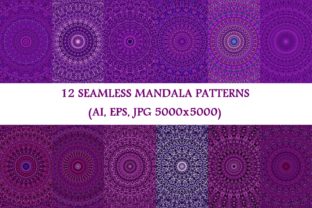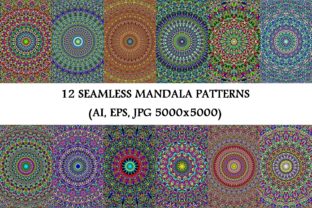
12 Floral Mandala Seamless Patterns
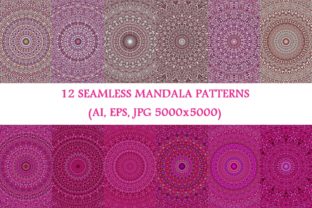
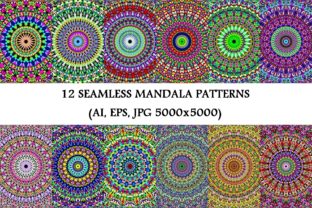
Floral mandalas combine organic elegance with geometric precision—making them ideal for branding, print design, textile work, digital backdrops, and mindful creative projects. The 12 Floral Mandala Seamless Patterns package delivers a thoughtfully curated set of versatile, high-fidelity designs. Each pattern repeats flawlessly across any surface, eliminating visible seams or misaligned edges—a critical detail many overlook when sourcing decorative assets.
Why these patterns stand out—and why that matters
Unlike generic floral repeats or low-resolution clipart, this collection is built for real-world use. Every pattern comes in three essential formats: vector AI files (editable in Adobe Illustrator), vector EPS files (compatible with older software and print workflows), and high-res JPGs (5000×5000 pixels, RGB, 300 DPI). That means you’re not just getting pretty images—you’re getting production-ready assets that scale infinitely, adapt to color changes, and hold up in both web and large-format print.
Beginners often assume “seamless” is automatic—but it’s not. Many free or low-cost downloads claim seamlessness while hiding subtle alignment flaws, inconsistent line weights, or mismatched petal spacing. Those imperfections become glaring at larger sizes or when tiled across packaging, fabric, or wall graphics. With the 12 Floral Mandala Seamless Patterns, each repeat was manually refined and stress-tested across multiple tile sizes and zoom levels—so what looks clean at 100% also holds up at 400% or across a 6-foot banner.
Common oversights—and how they quietly undermine your work
Mistake #1: Assuming all file types serve the same purpose. A JPG may look great on a website background, but it won’t scale cleanly for a logo lockup or embroidery digitizing. Using the wrong format can mean pixelation, color shifts, or wasted time re-tracing artwork. Always match the file type to the output: use AI/EPS for editing, branding, or cutting machines; reserve JPG only for fixed-size web use or quick mockups.
Mistake #2: Skipping the tile preview before purchase. Some sellers show only a single isolated mandala—not the actual repeating unit. Without seeing how the pattern behaves over a 2×2 or 3×3 grid, it’s impossible to assess rhythm, density, or visual weight. This leads to surprises: a pattern that feels too busy on apparel, or too sparse on stationery. Before downloading, open one of the JPGs in an image editor and duplicate the canvas—tile it manually to observe flow and balance.
Mistake #3: Ignoring color mode and embed compatibility. These files ship in RGB (ideal for screen use) but aren’t pre-converted to CMYK. If you’re sending files directly to a commercial printer, convert carefully—or better yet, rebuild swatches in your layout software using Pantone references where brand accuracy matters. Also, verify that your version of Illustrator supports the AI file version included (CS6+ is safe; anything older may require EPS fallback).
What to check before using—or buying—any floral mandala pattern set
- Tile dimensions: Seamless doesn’t mean “infinitely scalable without planning.” Check the native repeat size (e.g., 2000×2000 px or 10×10 inches at 300 DPI). Smaller tiles offer more flexibility for small items like stickers or social posts; larger ones suit wallpaper or fabric but may require extra memory or processing power.
- Design integrity: Zoom in on junction points—the center of the mandala, petal overlaps, stem connections. Do lines meet cleanly? Are stroke weights consistent? Fuzzy joins or duplicated anchor points suggest rushed vector cleanup, which makes future edits harder.
- Licensing clarity: This package permits commercial use—including merchandise, client work, and digital products—with no attribution required. But always confirm whether extended licenses (e.g., for resale as part of a template bundle) are included or need separate purchase.
- Color versatility: These patterns use layered vector objects—not flat raster fills—so you can easily recolor individual petals, stems, or backgrounds using Illustrator’s Recolor Artwork tool. That’s invaluable for matching brand palettes without outsourcing edits.
Better approaches for real projects
Let’s say you’re designing custom wrapping paper for a small-batch candle brand. Instead of stretching a single mandala across the sheet (which breaks rhythm), drop one of the seamless patterns into Illustrator, define your tile size to match standard paper rolls (e.g., 24×36 inches), then export as a PDF/X-4 for print. You’ll get crisp edges, predictable color behavior, and zero tiling artifacts—even after dozens of repeats.
For educators or therapists using mandalas in wellness activities, the JPG versions work beautifully in Canva or PowerPoint—just resize to fit slide dimensions and lock the aspect ratio. Because each is 5000×5000, you retain clarity even when zooming in during live sessions or printing handouts at 150% scale.
Freelancers building brand kits often make the mistake of applying mandalas only as full-page backgrounds. Try subtler uses instead: extract a single petal cluster as a bullet icon, use a stem motif as a divider line, or overlay a low-opacity mandala behind body text for texture—without sacrificing readability. The vector nature of these files makes those micro-adaptations fast and precise.
A final note on value and longevity
This isn’t disposable design. These 12 Floral Mandala Seamless Patterns were created with longevity in mind—not trend-chasing. They avoid overly stylized flourishes that date quickly and favor balanced proportions, botanical authenticity, and repeat logic that works across cultures and contexts. That means the set stays useful whether you’re launching a new Shopify store next month or updating your teaching materials three years from now.
It’s also worth noting: you’re not paying for 12 identical variations. Each pattern has its own character—some emphasize delicate vines, others feature bold symmetry or layered depth. That variety lets you align visuals with tone: soft watercolor-inspired repeats for wellness brands, tighter geometry for tech-adjacent creatives, or lush layering for artisanal packaging.
If you’ve ever spent hours trying to fix a “seamless” pattern only to find gaps at the edges—or paid for premium assets that wouldn’t open in your software—this package solves those issues upfront. It respects your time, your tools, and your standards. And because everything is delivered instantly with no subscription or watermark, you own it outright—ready to use today, tomorrow, and for every project after.