Donuts Seamless Patterns: Practical Tips for Getting Real Value From Your Design Assets
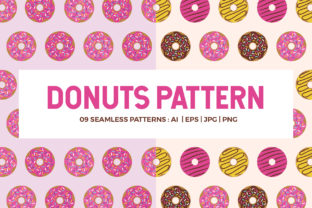
If you've ever spent hours trying to tile a background only to spot visible seams, misaligned repeats, or pixelated edges—especially at print size—you know how frustrating subpar patterns can be. Donuts Seamless Patterns solves that. It’s a thoughtfully built collection of 9 versatile, truly seamless designs—each crafted to repeat flawlessly across surfaces, whether you're designing stationery, apparel, fabric prints, digital presentations, or marketing collateral.
What’s Inside—and Why Format Variety Matters More Than You Think
The package includes one AI file with all 9 patterns on a single artboard—ideal for quick previewing and editing in Adobe Illustrator. But here’s where many users stumble: they assume the AI file is all they need. It’s not. You also get:
- 9 JPEG files (2000px × 2000px) — great for web previews, mood boards, or quick mockups where transparency isn’t needed;
- 9 PNG files (2000px × 2000px, with transparent backgrounds) — essential for layering over photos, logos, or textured surfaces without white boxes;
- 9 EPS files (2000px × 2000px) — scalable vector-compatible versions, useful for large-format printing or adapting into embroidery or laser-cut templates.
Skipping any of these formats means limiting your flexibility. For example, using only the JPEGs for apparel mockups may force you to manually remove white backgrounds—or worse, settle for low-res results when scaling up. A designer creating custom tote bags once tried stretching a JPEG beyond 3000px and ended up with blurry edges and client rework. With the included PNG or EPS, that problem vanishes.
A Common Misstep: Assuming “Seamless” Means “Ready for Any Use Case”
“Seamless” describes how the pattern repeats—not how it performs across contexts. Donuts Seamless Patterns are built for reliability, but their effectiveness still depends on *how* and *where* you apply them.
One frequent oversight? Using high-resolution patterns without checking color mode. If you’re prepping for CMYK fabric printing, opening the RGB JPEG in Photoshop and exporting straight to print without converting can shift pastel pinks toward magenta or mute warm donut glazes. The AI and EPS files preserve editable color swatches—so adjust hues in Illustrator first, then export in the correct profile.
Another subtle issue: scale perception. At 2000px × 2000px, these patterns look balanced on screen—but fabric repeats often require larger tiles for visual impact, while stationery might call for subtler, tighter repeats. Test your chosen pattern at actual output size: paste it into a 12″ × 12″ document set to 300 DPI and zoom to 100%. Does the motif feel too dense on business cards? Too sparse on a scarf mockup? Adjust tiling scale *before* finalizing layouts—not after.
Why File Organization Is a Quiet Superpower
You’ll receive 36 total files—9 per format. That sounds manageable until you rename three PNGs, lose track of which EPS matches which donut style, and waste 20 minutes hunting. Avoid this by renaming consistently *immediately*: donuts-honeyglaze-png, donuts-honeyglaze-eps, etc. Bonus tip: keep them in clearly labeled subfolders (/png/, /eps/) rather than dumping everything into one folder. It takes two minutes upfront and saves hours over time—especially if you license multiple pattern sets later.
What to Check Before You Buy—or Before You Apply
Before downloading or integrating Donuts Seamless Patterns into a live project, ask yourself three practical questions:
- Is the resolution appropriate for my output? Web banners? JPEG or PNG at 2000px works fine. Large wall decals or yardage? Open the EPS in Illustrator, scale the artboard to your required repeat size (e.g., 6″ × 6″), and re-export as a high-DPI PDF or TIFF.
- Do I need editable vectors—or just raster assets? If you plan to recolor, isolate elements, or adapt motifs for embroidery digitizing, prioritize the AI or EPS. If you’re adding a subtle background to a Canva social post, the PNG will do.
- Does the pattern’s rhythm suit the medium? Busy, high-contrast donut arrangements shine on tote bags or leggings—but may overwhelm minimalist letterhead. Try overlaying a light 15% opacity version on your layout first. If text becomes hard to read or visual hierarchy blurs, switch to a lower-contrast variant from the set.
Real-World Use Cases That Highlight Smart Choices
A small-batch ceramic studio used Donuts Seamless Patterns to design packaging labels. They started with the JPEGs—then realized their label printer required CMYK TIFFs with bleed. Instead of re-downloading or re-rendering, they opened the AI file, adjusted colors to match their brand Pantones, added 1/8″ bleed, and exported cleanly. Result: zero color surprises, no delays.
A freelance educator building printable classroom resources chose the PNGs with transparency. She layered the “sprinkled-donut” pattern behind student worksheets—no white boxes interrupting themed borders. When she later adapted the same resource for Google Slides, she reused the same PNG, resized proportionally, and kept visual continuity across platforms.
A Final Note on Long-Term Usability
Donuts Seamless Patterns isn’t just about convenience—it’s about consistency. Having one trusted source for coordinated, production-ready repeats means fewer licensing headaches, no mismatched scales between projects, and less time troubleshooting repeats. But that value only activates when you use the right file for the right job, test early, and organize intentionally.
Think of it like having nine reliable kitchen knives: each has a purpose. Using the paring knife to chop cabbage won’t break it—but it’ll take longer and feel off. Choose the format that fits your task, verify before committing, and keep your system tidy. That’s how you turn a simple pattern pack into a quietly powerful part of your creative workflow.