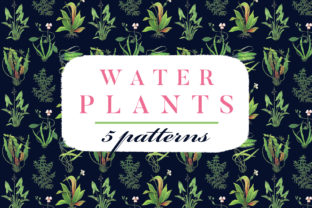
Water Plants Patterns: Botanical Design Assets for Creative Versatility
Water plants—lotuses, water lilies, duckweed, reeds, and submerged aquatics—have long inspired visual culture. Their rhythmic forms, layered textures, and serene symbolism translate powerfully into repeatable design elements. Water Plants Patterns are not merely decorative motifs; they’re functional, scalable, and contextually adaptive botanical assets built for real-world creative workflows. Unlike generic floral repeats, these patterns reflect ecological accuracy in silhouette, proportion, and growth logic—making them especially valuable for designers who prioritize authenticity alongside aesthetics.
Why Botanical Accuracy Matters in Pattern Design
Many pattern libraries offer stylized or abstracted plant motifs—but when water plants appear in educational materials, conservation campaigns, wellness branding, or nature-based apps, fidelity supports credibility. A correctly rendered lotus leaf shows the characteristic waxy, self-cleaning surface texture; a water lily stem exhibits subtle tapering and node spacing; submerged milfoil displays feathery, segmented branching. These details aren’t ornamental—they reinforce visual literacy. Educators use such precision to teach plant morphology; researchers embed them in outreach visuals to signal scientific rigor; UX designers leverage them to evoke calm, clarity, and natural balance without cliché.
The 5 Water Plants Patterns collection was developed with this intentionality. Each pattern originates from high-resolution field photography and botanical illustration references—not AI-generated approximations. The result is a set of repeatable tiles that retain structural integrity at any scale, whether printed on a 48-inch poster or rendered at 300DPI on a luxury greeting card.
Technical Specifications Designed for Production Use
Every pattern in the collection ships as two complementary file types:
- PAT files (Photoshop patterns): Seamlessly tile across layers in Adobe Photoshop, compatible with brushes, fills, and smart objects. Ideal for rapid prototyping, mockup integration, and batch editing.
- High-resolution PNGs (4000×4000 pixels, 300DPI): Transparent-background raster files optimized for print and digital export. No compression artifacts, no color profile mismatches—ready for immediate placement in Illustrator, Figma, Canva, or web CMS platforms.
This dual-format approach eliminates workflow friction. A packaging designer can apply the pattern as a seamless fill behind product copy in Photoshop, then export the final layout using the matching PNG for precise color control in CMYK prepress. A mobile app developer drops the same PNG directly into an asset catalog—no tiling code required—and scales it responsively via CSS background properties.
For Educators and Science Communicators
Classroom posters featuring accurate water plant repeats help students distinguish between emergent, floating-leaved, and submerged species at a glance. One educator reported using the “Cattail Reed Grid” pattern as a background for a wetland ecology slide deck—students consistently referenced the repeating nodes and seed-head clusters during discussions about plant adaptation. The transparency of the PNGs allows overlays of labeled diagrams or animated callouts without visual competition.
For Brand Strategists and Sustainable Businesses
Eco-conscious brands—from organic skincare lines to river restoration nonprofits—leverage water plant motifs to communicate purity, resilience, and interdependence. A reusable water bottle company used the “Lotus Petal Radial” pattern as a subtle wrap-around texture on its product photography backgrounds. Because the pattern’s color palette was built from muted, low-saturation greens and soft creams—not bright artificial tones—it reinforced their “unfiltered nature” messaging without appearing gimmicky.
For Digital Product Teams
In UI design, repetition signals rhythm and predictability—qualities aligned with water plant growth patterns. One fintech team integrated the “Duckweed Cluster” motif as a subtle loading animation background: tiny floating elements drift at varying speeds, mimicking natural water movement while conveying system activity. The 4000×4000 resolution ensured crisp rendering on 5K monitors and Retina displays alike.
For Print and Packaging Professionals
Because all patterns are delivered at true 300DPI, they hold detail even under magnification—critical for luxury stationery or artisanal tea packaging. A small-batch herbal apothecary applied the “Water Lily Vein Repeat” as a foil-stamped border on kraft paper gift boxes. The fine vein structure resolved cleanly at 12-point size, avoiding the blurring common with upscaled lower-resolution assets.
Design Flexibility Without Compromise
Each of the five patterns balances restraint and richness:
- Lotus Petal Radial: A concentric, symmetrical repeat evoking sacred geometry—ideal for meditation app interfaces or yoga studio branding.
- Water Lily Surface: A gentle, overlapping leaf-and-flower arrangement with intentional negative space—suited for breathable layouts like newsletters or presentation templates.
- Cattail Reed Grid: Vertical, linear rhythm suggesting structure and stability—frequently used in architectural visualization backdrops and civic project reports.
- Duckweed Cluster: Irregular, organic scattering ideal for representing ecosystems, data networks, or decentralized systems in infographics.
- Submerged Milfoil Flow: Horizontal, undulating stems with delicate branching—popular for aquatic-themed websites, spa branding, and fluid motion graphics.
None rely on over-saturation or heavy contrast—making them easy to recolor non-destructively in design software. A single hue shift transforms “Submerged Milfoil Flow” from freshwater documentation into marine conservation collateral; lightening “Cattail Reed Grid” creates a minimalist textile preview for sustainable fashion lookbooks.
Integration Considerations for Long-Term Projects
While Water Plants Patterns offer immediate usability, thoughtful implementation ensures longevity. First, consider licensing scope: these assets are royalty-free for commercial use, but redistribution as standalone patterns—or inclusion in template marketplaces without significant original modification—is prohibited. Second, maintain color integrity by embedding ICC profiles when exporting for print; the PNGs include sRGB profiles by default, suitable for most digital displays and calibrated offset workflows.
Third, test at multiple scales. A pattern that reads beautifully at 200% zoom may break down at thumbnail size if node density is too high. All five patterns were stress-tested from 64×64-pixel favicon previews up to billboard-scale murals—their 4000×4000 resolution provides ample headroom for cropping, zooming, or generating derivative SVG variants via vector tracing.
How These Patterns Fit Within Broader Creative Trends
Biophilic design continues to shape environments where people live, work, and learn—evidenced by LEED v4.1’s expanded criteria for natural pattern integration and the rise of “eco-aesthetic” branding in B2B SaaS. Yet many implementations fall into predictable tropes: generic leaf silhouettes, overused fern vectors, or gradient-heavy “nature” overlays. Water Plants Patterns respond to this gap by offering regionally neutral, taxonomically grounded alternatives rooted in aquatic botany—a niche with growing relevance amid climate-driven wetland restoration efforts and urban water management initiatives.
They also align with the maturation of design systems. Rather than treating patterns as afterthoughts, forward-thinking teams now bake them into foundational tokens—defining “water plant repeat” as a semantic layer alongside typography scales and spacing tokens. This enables consistent application across touchpoints: the same “Duckweed Cluster” appears as a subtle hover effect on a website navigation item, a watermark on internal slide decks, and a tactile emboss on annual report letterhead.
Practical Next Steps for Immediate Use
Start small. Import one PAT file into Photoshop and create a new document at 1920×1080 pixels. Fill a layer with the pattern, then adjust blend mode to “Overlay” at 15% opacity—this often reveals unexpected texture depth without overwhelming content. For web use, upload the matching PNG to your site’s assets folder and declare it as a CSS background-image with background-size: 200px; and background-repeat: repeat;. Adjust the pixel value until the rhythm feels balanced against your typography.
When preparing for print, open the PNG in Photoshop, convert to CMYK if required, and run a soft-proof simulation using your printer’s ICC profile. You’ll likely find minimal adjustment is needed—the patterns were built with wide-gamut RGB primaries that translate cleanly to coated and uncoated stocks.
Ultimately, Water Plants Patterns succeed not because they’re novel, but because they resolve persistent practical needs: ecological authenticity, production-ready fidelity, cross-platform adaptability, and quiet visual intelligence. They don’t shout for attention—they support meaning, clarify intent, and endure across contexts precisely because they were designed to recede gracefully, not dominate.